


- PRESS RELEASE
New data release: ECB wage tracker continues to suggest normalisation of negotiated wage pressures in 2026
11 February 2026
- ECB wage tracker updated with wage agreements signed up to mid-January 2026; forward-looking horizon remains unchanged at end-December 2026
- Forward-looking information continues to indicate that negotiated wage growth will level off at below 3% by the end of 2026
- ECB wage tracker with unsmoothed one-off payments at 3.0% in 2025 and 2.7% in 2026
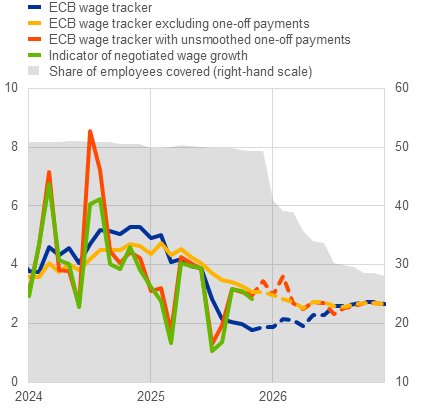
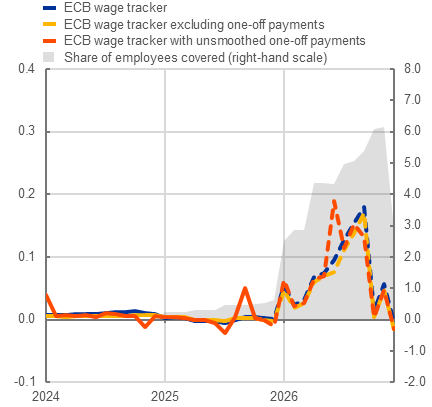
The European Central Bank (ECB) wage tracker, which covers active collective bargaining agreements, indicates negotiated wage growth with smoothed one-off payments of 3.2% in 2025 (based on a coverage of 49.9% of employees in participating countries) and 2.4% in 2026 (based on a coverage of 33.1%). Compared with the December 2025 data release, the ECB wage tracker with smoothed one-off payments was revised up by 0.1 percentage points for 2026. The ECB wage tracker with unsmoothed one-off payments indicates negotiated wage growth of 3.0% in 2025 and 2.7% in 2026. The wage tracker excluding one-off payments indicates an easing of negotiated wage growth from 3.9% in 2025 to 2.7% in 2026 (revised up by 0.1 percentage points for 2026).
The headline ECB wage tracker is better suited to describing quarterly or monthly dynamics in negotiated wages as it smooths one-off payments over time. Meanwhile, the ECB wage tracker with unsmoothed one-off payments is better suited to describing yearly dynamics, ensuring that one-off payments are not smoothed twice when constructing the yearly outcomes.
For 2026 the headline ECB wage tracker stands at 2.1% in the first half of the year and at 2.7% in the second half of the year. The rise in the wage path over the course of the year is related to the dissipation of the mechanical downward effect of large one-off payments that were made in 2024 but not in 2025. These mechanical effects are expected to virtually disappear over the course of 2026, and the wage trackers with one-off payments (smoothed and unsmoothed) and without one-off payments are expected to converge as such payments become less relevant. The ECB wage tracker also suggests that there is less dispersion in negotiated wage pressures across the different euro area countries in 2026 than in previous years.
The ECB wage tracker with unsmoothed one-off payments also reflects a more stable and less volatile outlook for negotiated wage growth in 2026 (2.9% in the first half of the year, 2.6% in the second half) compared with previous years. The wage tracker excluding one-off payments stands at 2.7% for both the first and second half of 2026, also suggesting more moderate dynamics in negotiated base wages than in previous years. Employee coverage for 2026 stands at 37.1% for the first half of the year and 29.2% for the second half. See Chart 1 and Table 1 for further details.
For this data release, the forward-looking horizon of the wage tracker remains unchanged at December 2026. As new agreements are being signed and coverage of contracts reaching beyond 2026 is gradually increasing, the forward-looking horizon of the wage tracker will be extended to the first quarter of 2027 in the July 2026 data release.
Overall, the ECB wage tracker may be subject to revisions, and the forward-looking component should not be interpreted as a forecast, as it only captures information that is currently available for active collective bargaining agreements. Moreover, the ECB wage tracker does not track the indicator of negotiated wage growth precisely, and deviations are to be expected over time. For a more comprehensive assessment of wage developments in the euro area, please refer to the December 2025 Eurosystem staff macroeconomic projections for the euro area, which indicate a yearly growth rate of compensation per employee in the euro area of 4.0% in 2025 and 3.2% in 2026.
The ECB publishes four wage tracker indicators for the aggregate of the nine participating euro area countries on the ECB Data Portal.
Chart 1
ECB wage tracker: forward-looking signals for negotiated wages and revisions to the previous data release
Indicators between January 2024 and December 2026 | Revisions to previous data release |
|---|---|
(left-hand scale: yearly growth rates, percentages; right-hand scale: percentage share of employees) | (percentage points) |
 |  |
Sources: ECB calculations based on data provided by the Nationale Bank van België/Banque Nationale de Belgique, the Belgian Federal Public Service Employment, Labour and Social Dialogue, the Belgian National Social Security Office, the Deutsche Bundesbank, the Bank of Greece, the Banco de España, the Banque de France, the Banca d’Italia, the Dutch employers’ association AWVN, the Oesterreichische Nationalbank, Suomen Pankki – Finlands Bank, the Confederation of Finnish Industries, Statistics Finland and Eurostat. The indicator of negotiated wage growth is calculated using data from the Belgian Federal Public Service Employment, Labour and Social Dialogue, the Deutsche Bundesbank, the Spanish Ministry of Labour and Social Economy, the Banque de France, the Italian National Institute of Statistics (ISTAT), Statistics Netherlands, Statistics Austria, Statistics Finland, Haver Analytics and Eurostat.
Notes: The methodology for the forward-looking indicator in France has been updated since the December 2025 data release. Previously, all contracts for which a new agreement had not been reached were included in the indicator assuming zero wage growth. The new approach assumes that only a share of these contracts will have zero wage growth, with the share being based on developments in the previous year. This is aimed at providing a more accurate assessment of negotiated wage pressures in periods with gaps in agreement renewals in order to avoid large revisions in future data releases (details can be found in the metadata).
Dashed lines denote forward-looking information (which is not yet available for the indicator of negotiated wage growth). The latest observations are for December 2026 for the ECB wage tracker indicators (left panel), November 2025 for the indicator of negotiated wage growth (left panel) and December 2026 for revisions to the previous data release (right panel).
What do the four different indicators show?
- The headline ECB wage tracker is a tracker of negotiated wage growth that includes collectively agreed one-off payments, such as those related to inflation compensation, bonuses or back-dated pay, which are smoothed over 12 months.
- The ECB wage tracker excluding one-off payments reflects the extent of structural (or permanent) negotiated wage increases.
- The ECB wage tracker with unsmoothed one-off payments is constructed using a methodology that, in terms of both data sources and statistical methodology, is conceptually similar to, but not necessarily the same as, that used for the ECB indicator of negotiated wage growth.
- The share of employees covered is the percentage of employees across the participating countries that are directly covered by ECB wage tracker data. This indicator provides information on the representativeness of the underlying (negotiated) wage growth signals obtained from the set of wage tracker indicators for the aggregate of the participating countries. Employee coverage differs across countries and within each country over time (more details can be found in Table 2).
Table 1
ECB wage tracker summary
(percentages)
ECB wage tracker | Coverage | |||
|---|---|---|---|---|
Headline indicator | With unsmoothed one-off payments | Excluding one-off payments | Share of employees (%) | |
2013-24 | 2.2 | 2.3 | 2.1 | 49.5 |
2025 | 3.2 | 3.0 | 3.9 | 49.9 |
2026 | 2.4 | 2.7 | 2.7 | 33.1 |
Q1 2025 | 4.7 | 2.7 | 4.5 | 50.0 |
Q2 2025 | 4.0 | 4.1 | 4.3 | 50.2 |
Q3 2025 | 2.3 | 2.1 | 3.5 | 49.9 |
October 2025 | 2.0 | 3.1 | 3.3 | 49.4 |
November 2025 | 1.8 | 3.0 | 3.1 | 49.4 |
December 2025 | 1.9 | 3.4 | 3.1 | 49.4 |
January 2026 | 1.9 | 3.0 | 3.0 | 41.1 |
February 2026 | 2.2 | 3.6 | 2.8 | 39.1 |
March 2026 | 2.1 | 2.7 | 2.7 | 38.9 |
Q2 2026 | 2.2 | 2.6 | 2.7 | 34.5 |
Q3 2026 | 2.6 | 2.5 | 2.6 | 29.9 |
Q4 2026 | 2.7 | 2.7 | 2.7 | 28.5 |
Sources: ECB calculations based on data provided by the Nationale Bank van België/Banque Nationale de Belgique, the Belgian Federal Public Service Employment, Labour and Social Dialogue, the Belgian National Social Security Office, the Deutsche Bundesbank, the Bank of Greece, the Banco de España, the Banque de France, the Banca d’Italia, the Dutch employers’ association AWVN, the Oesterreichische Nationalbank, Suomen Pankki – Finlands Bank, the Confederation of Finnish Industries, Statistics Finland and Eurostat.
Notes: ECB wage tracker indicators reflect yearly growth in negotiated wages as a percentage. Coverage is defined as the share of employees in participating countries as a percentage. Rows with values in italics and bold refer to the forward-looking aspect of the respective indicators. Data are subject to revisions.
Table 2
Employee coverage by country
(share of employees in each country, percentages)
Belgium | Germany | Greece | Spain | France | Italy | Netherlands | Austria | Finland | Euro area | |
|---|---|---|---|---|---|---|---|---|---|---|
2013-24 | 38.2 | 42.5 | 10.7 | 62.4 | 52.1 | 48.7 | 64.1 | 60.4 | 66.3 | 49.5 |
Q1 2025 | 44.7 | 45.0 | 19.2 | 49.1 | 56.2 | 47.4 | 62.5 | 77.5 | 62.5 | 50.0 |
Q2 2025 | 44.8 | 45.9 | 16.7 | 49.1 | 56.2 | 47.7 | 62.0 | 76.4 | 62.6 | 50.2 |
Q3 2025 | 44.8 | 46.0 | 10.3 | 48.9 | 56.0 | 47.6 | 61.6 | 76.1 | 62.7 | 49.9 |
Q4 2025 | 44.8 | 45.8 | 10.3 | 48.6 | 54.4 | 47.5 | 61.4 | 75.7 | 62.4 | 49.4 |
Q1 2026 | 44.9 | 41.2 | 10.1 | 27.9 | 33.6 | 46.0 | 57.4 | 61.1 | 62.3 | 39.7 |
Q2 2026 | 44.8 | 35.0 | 9.9 | 26.5 | 21.4 | 45.8 | 56.0 | 48.0 | 62.2 | 34.5 |
Q3 2026 | 44.8 | 27.1 | 9.8 | 22.9 | 16.3 | 45.7 | 52.4 | 42.2 | 59.7 | 29.9 |
Q4 2026 | 44.7 | 26.5 | 9.8 | 22.3 | 12.7 | 44.7 | 49.3 | 40.3 | 57.5 | 28.5 |
Sources: ECB calculations based on data provided by the Nationale Bank van België/Banque Nationale de Belgique, the Belgian Federal Public Service Employment, Labour and Social Dialogue, the Belgian National Social Security Office, the Deutsche Bundesbank, the Bank of Greece, the Banco de España, the Banque de France, the Banca d’Italia, the Dutch employers’ association AWVN, the Oesterreichische Nationalbank, Suomen Pankki – Finlands Bank, the Confederation of Finnish Industries, Statistics Finland and Eurostat.
Notes: The euro area aggregate comprises the nine participating wage tracker countries. The coverage shows the relative strength of wage signals for each country and the euro area. The historical average is calculated from January 2015 for Finland, January 2016 for Greece and February 2020 for Austria. For the other countries, it is calculated from January 2013 to December 2024. Rows with values in italics and bold refer to the forward-looking aspect of the indicator. Data are subject to revisions.
For media queries, please contact Benoit Deeg, tel.: +491721683704
Notes:
- The ECB wage tracker is the result of a Eurosystem partnership currently comprising the ECB and nine euro area national central banks: the Nationale Bank van België/Banque Nationale de Belgique, the Deutsche Bundesbank, the Bank of Greece, the Banco de España, the Banque de France, the Banca d’Italia, De Nederlandsche Bank, the Oesterreichische Nationalbank and Suomen Pankki – Finlands Bank. It is based on a highly granular database of active collective bargaining agreements for Belgium, Germany, Greece, Spain, France, Italy, the Netherlands, Austria and Finland. The wage tracker can be used to help assess wage pressures in the euro area.
- The wage tracker methodology uses a double aggregation approach. First, it aggregates the highly granular information on collective bargaining agreements and constructs the wage tracker indicators at the country level using information on the employee coverage within each country. Second, it uses this information to construct the aggregate for the euro area using time-varying weights based on the total compensation of employees among the participating countries.
- Given that the forward-looking nature of the tracker is dependent on the underlying collective bargaining agreements database, the wage signals should always be considered conditional on the information available at any given point in time and thus subject to revisions. This is particularly relevant at the turn of the year, as many agreements are signed or renewed in the first quarter in some countries.
- The results in this press release do not represent the views of the ECB’s decision-making bodies.
Europejski Bank Centralny
Dyrekcja Generalna ds. Komunikacji
- Sonnemannstrasse 20
- 60314 Frankfurt am Main, Niemcy
- +49 69 1344 7455
- media@ecb.europa.eu
Przedruk dozwolony pod warunkiem podania źródła.
Kontakt z mediami