


- INTERVIEW
Interview with Econostream Media
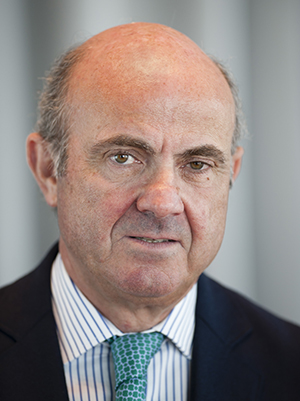
Interview with Luis de Guindos, Vice-President of the ECB, conducted by Marta Vilar on 6 February 2026
10 February 2026
Vice-President de Guindos, you have said the ECB would adjust its policy if changing conditions warranted it. What kinds of developments would prompt a shift in policy, either upward or downward?
Let me start by elaborating on the outlook. The economy has proven more resilient than we had projected, which is good news. Leading indicators even suggest that growth in the first quarter of 2026 is likely to exceed most of the projections. Headline inflation stands at 1.7%, while core inflation has declined and is moving closer to our target. This was factored into our projections, as we knew that some base effects would occur – and they have occurred. As a result, we are in a better position in terms of growth, and inflation is converging to target.
Among the risks we foresee, the first is the geopolitical situation, including developments in Ukraine, the Middle East and Iran, which we must take into account. This is why we are very prudent in our monetary policy stance. Second, China is becoming our main competitor, both overseas – due to its gains in competitiveness and the fact that both the quality of its products and the composition of Chinese exports are very similar to Europe’s – and in the domestic market, where penetration of Chinese products is becoming more and more evident. This is something we must bear in mind, especially given that the trade agreement between China and the United States has yet to be finalised. If we were to see additional trade diversion toward Europe, we would need to be very vigilant. Chinese exports could have a downward impact on both inflation and growth.
Given the circumstances and these potential risks, we believe that the current level of interest rates is appropriate. And we need to maintain an open-minded approach to the future direction of monetary policy.
I see you are mainly highlighting downside risks. Is it because you see downside risks as more important than those on the upside?
Risks are balanced, but the ones I highlighted could become more tangible and relevant sooner. Of course there are other risks, like the recovery being stronger than projected due to potentially higher consumer spending, or fiscal policies being more expansionary, and this would be a short-term upside risk.
President Lagarde only mentioned the “good place” on Thursday when asked about it. Eventually the “good place” will come to an end. What do you see as the most likely development to bring this about?
I have just outlined what I see as the main risks. When one says that we are in a “good place,” it has to be put into context. Personally, I find that the term might lead to misunderstandings. I prefer to say that the economy is more resilient and that inflation is converging toward our target. This makes it clear that we are in a comfortable position with respect to the evolution of inflation. However, one cannot ignore the fact that price levels remain very high for consumers. At the same time, growth is very close to potential, but it is not particularly strong. So, it is important to clarify that when one says “good place,” it refers to the economy and inflation moving in the right direction.
Are markets misunderstanding the “good place” as too static?
I was now referring to consumer perceptions. Markets understand our monetary policy stance and what we are doing. Our communication is clear. However, it is necessary to explain what is meant by being in a “good place.”
Unlike the December press conference, President Lagarde in February did not explicitly say “all options” were on the table, but she did imply it. Some observers interpreted the reference to full optionality as reopening the possibility of rate hikes. Was that the intended message?
Markets tend to scrutinise even the slightest changes. But we don’t always express ourselves in exactly the same way. I certainly don’t. What I can say is that our monetary policy stance has not changed between the December meeting and this one.
You mainly highlighted downside risks. So, is it fair to say now that the burden of proof for rate hikes is lower than that for further rate cuts?
That is your conclusion, not mine. Our communication is clear, we give no forward guidance, we are data-dependent and approach each meeting with open minds.
Markets are currently pricing in the first rate hike in the second half of 2027. Are you comfortable with those expectations?
Markets have to make bets and I treat them as relevant signals. But they can sometimes be mistaken – which is not to say that I think this is the case now. It is also important to bear in mind that markets are influenced by what we say. We are currently in a comfortable position but circumstances can change and then market expectations would adjust immediately. Markets are volatile, but we cannot be.
The ECB had anticipated some inflation undershooting in early 2026. Do the latest flash CPI data for January fall broadly within your expectations? Do these data concern you in any way?
It was in line with our expectations. We clearly indicated that headline inflation would fall below 2% in early 2026, and that has been the trajectory so far. It is also important to remember that flash estimates can sometimes be revised. I understand that markets focus closely on individual data points, but the overall trend is in line with what we had projected.
How far would inflation have to decline for an undershoot to go beyond what you expect?
It would depend on the composition. I can say that this latest reading did not come as a surprise.
Looking at this reading’s composition, did any elements – such as services inflation being weaker than expected or energy prices declining significantly after the recent spike – come as a surprise to you?
Energy inflation was lower than expected, but there is a lot of volatility at the moment. Services inflation is moving in the right direction. The fact that services inflation came in one or two decimal points below expectations is not particularly important; what matters is its trajectory and direction. And we are comfortable with those.
The latest bank lending survey showed that credit standards had tightened further for firms and consumer lending. Does this concern you in any way?
We are monitoring lending conditions closely because they provide information about the transmission of our monetary policy stance. There has been a very marginal tightening of conditions for corporates, which is more closely linked to banks’ sentiment and confidence about the economy, as well as the level of uncertainty. For mortgages our stance has been fully transmitted, but for corporates, we still need to assess the situation. There are also some composition effects, as the tightening is concentrated in specific sectors that are more exposed to trade tensions.
On 14 January you noted that geopolitical risks were significantly increasing downside risks to growth. Is that still the case despite the withdrawal of the new US tariff threat?
The situation is better than it was three weeks ago, as there is now a bit more clarity. But it is hard to know what could happen in another three weeks, as volatility remains very high.
Do you expect the current increase in downside risks to growth to translate into meaningful downside risks to inflation?
The implicit risk of a trade conflict between the United States and Europe has receded. Whether these risks to growth prove inflationary or disinflationary will need to be assessed. We have been clear that tariffs are inflationary in the very short term but in the medium term their impact could be deflationary because of weaker demand, while over the longer term protectionism can lead to fragmentation and higher price pressures.
You said the increase of low-priced Chinese exports to Europe is becoming more evident. To what extent do you expect this to feed through to headline inflation, and over what timeframe might such effects become visible?
It takes time. No one can accurately estimate how long the effects will take to materialise, but the trend is far more important than individual data points.
Many observers consider the impact of Chinese rerouting on inflation to be underestimated in the staff projections – do you agree?
We are comfortable with the assumptions. While the projections do not dovetail perfectly with reality, we remain very comfortable with them.
You said in January that forward-looking indicators suggested a slowdown in wage growth in coming quarters. Which indicators do you watch most closely, and how confident are you that this slowdown will materialise?
We have a range of indicators, including our wage tracker. Again, it is not a question of a specific threshold; what matters more is the evolution. The trajectory across all measures – such as compensation per employee and collective bargaining agreements – points in the same direction: moderation.
The euro has appreciated sharply against the dollar recently, driven by several factors weighing on the dollar’s attractiveness, but has since returned to around USD 1.18. How concerned are you?
We do not target the exchange rate, as you know. But, for an open economy like the euro area, it is a very important variable so we monitor it very closely. The evolution of the EUR/USD exchange rate depends on developments in Europe and, in addition, on US policies. It has hovered around 1.16-1.18 for a long period. There was a brief uptick recently but we are now back to that range, which is fully consistent with the assumptions included in our projections. There have been no surprises in that regard, but we remain attentive to the evolution of the EUR/USD exchange rate.
Is it fair to say that a weakening of the US dollar would be more problematic for euro area inflation if it were accompanied by depreciation in other currencies, or if it were driven by euro strength?
One needs to look at the trade-weighted nominal exchange rate. What happens with the US dollar is important because commodities such as oil and metals are priced in dollars. However, we need to take a broader view of the exchange rate. As well as focusing on the US dollar, we need to be aware of movements in other currencies, such as Chinese renminbi, Japanese yen or the Indian rupee.
Is the current appreciation less concerning because it is primarily driven by weakness in the US dollar?
It deserves attention but I do not see it as dramatic at all.
As you assess expansionary fiscal plans – such as Germany’s – how are you weighing rising defence spending across Europe and the political constraints some countries face? And how important is continued signalling on fiscal consolidation for maintaining sovereign bond market stability?
Germany is of course important, and we are carefully analysing the impact of the German Government’s expansionary fiscal plans, but we must avoid focusing too single-mindedly on a particular country. When it comes to fiscal policy – first, defence spending needs to increase across Europe. This has become the top priority in the current geopolitical context. Second, as a consequence of political fragmentation, some countries face constraints in approval of their budgets.
At the same time, Europe has more fiscal space than the United States, as our deficit and public debt ratios are lower. However, challenges remain and calm markets cannot be taken for granted. Given political fragmentation and higher defence spending, it is essential that European governments continue to signal a commitment to fiscal consolidation. This will not be easy but it is crucial for ensuring stability in sovereign bond markets over time.
Is there any risk that delays to Germany’s implementation of higher fiscal spending could weigh on growth?
We need to assess how it evolves. Infrastructure programmes can be difficult to implement and may involve significant lags. As for defence spending, there are still questions about the size of the multiplier.
What is your view on Kevin Warsh as the new Chair of the Federal Reserve?
He is a knowledgeable person who knows how markets work and he understands the importance of central bank independence. In my view, it was a good choice.
Is it fair to say that he was the most sensible candidate out of those who were mentioned?
I don’t know the others. But Mr Warsh knows the Fed and I believe he will be a good Chair.
So, you are not as concerned about the Fed’s independence with Mr Warsh as Chair?
I’m sure he is aware of the importance of central bank independence.
How do you interpret the choice of Governor Boris Vujčić – from a newer Member State – to succeed you instead of someone from a core country like Governor Olli Rehn? And what advice would you offer your successor?
All the candidates were very strong. Boris brings a great deal of experience, having served as governor for many years and as a member of the Governing Council for some years as well. He is widely respected, has a clear understanding of the challenges ahead and has made important contributions to our discussions. My only complaint is that his tennis level is lower than mine.
This means that the ECB Vice-President will again be male. Looking ahead, how important should gender balance be when filling upcoming vacancies on the Board?
It was indeed unfortunate that there were no female candidates, and I hope the situation is reverted when future positions are filled.
Európska centrálna banka
Generálne riaditeľstvo pre komunikáciu
- Sonnemannstrasse 20
- 60314 Frankfurt nad Mohanom, Nemecko
- +49 69 1344 7455
- media@ecb.europa.eu
Šírenie je dovolené len s uvedením zdroja.
Kontakty pre médiá